Sunday, 5 April 2020

Holy Week and Easter: Celebrating in Isolation

I was brought up in a ‘middling’ but serious form of Anglicanism: neither particularly high nor noticeably low. Lent, Holy Week and Easter were observed solemnly, and our mediaeval parish church was always decked in gorgeous white flowers for Easter. The seasons of the Church became part of my life in childhood and grew in importance during my adolescence, when I was confirmed – after a due period of instruction. 

But it was in Greece, in 1984, that I first grasped, in something resembling its totality, the real possibility of Easter and its season of preparation. I was sixteen and on my first visit to Greece. We spent Holy Week and Easter on the island of Aegina. The island was carpeted with wildflowers and we walked extensively. As Holy Week progressed, I realised we were getting caught up in something I had never exactly experienced before: a whole community observing the Christian rituals together. Aegina Town has three large and beautiful churches, and we were in all of them at various times. For Good Friday, we headed to the Panagitsa, the lovely church dedicated to the Virgin on the harbour front. There the epitaphios (the representation of the Lord’s funeral bier) was sumptuous: its frame encrusted with seasonal wildflowers and carried aloft into the streets, with the bells tolling mournfully and the people following the procession. On Holy Saturday, I was surprised to find the tavernas largely closed at lunch and in the early evening; we ate alone in the apparently sole place that was open. Everyone else was observing the fast of the triduum. Later we were in the cathedral for the Easter vigil and the proclamation of the Resurrection at midnight. Since then, I have been present at many Greek Easter proclamations, but I shall never forget the excitement, the heat, the chaos, the joy of that first one. 

The bidding prayer for the Anglican service of imposition of ashes at the start of Lent exhorts us to observe a ‘holy Lent, by self-examination and repentance; by prayer, fasting, and self-denial; and by reading and meditating on God’s holy word’. These are demanding words, addressed to and binding on each observant Christian and requiring acts of individual preparation and penitence. But the exhortation is too tough for us to carry it out entirely on our own. And so the Church helps us throughout Lent by offering collective worship that gathers in its intensity and enables us to participate together first as a penitential community and then as a congregation living together the Easter triumph. It is a collective experience that challenges, encourages, cajoles, sustains and ultimately rewards the efforts of the individual soul.

I had planned to spend this holy season amid great congregations. I was intending to be at the Brompton Oratory with Catholic friends for Palm Sunday today; at Southwark Cathedral for Maundy Thursday; at Westminster Abbey for Good Friday; and at my local parish church, All Saints, for Easter Sunday. This is the first time for many years that none of this will happen – for me or for others, and it feels like a bereavement all of its own – particularly the loss of Good Friday and Easter Day: music, readings, prayers, acts of penitence, adoration, rejoicing. Like many others, I will have to do without the great congregational consolations and find substitutes in isolation: live transmission of private acts of worship; CDs and streaming of the passion oratorios; the great settings (Palestrina, Victoria) of the Gospel reading, the Improperia; the hymns of celebration.

Throughout Holy Week, I shall be reading from the Select Meditations of Thomas Traherne, a seventeenth-century poet, theologian and Anglican priest. The meditations are both intensely personal, reflecting intimately on Traherne’s relationship with God, and yet wonderfully outward-looking: with expositions on the Godhead, the beauty of the natural world, the Church, the nation, Traherne’s own ministry. The individual meditations are arranged into four 'centuries' (i.e. collections of 100) and are mostly short (sometimes as short as four lines), occasionally written in the form of poetry and, even in prose, always expressed with magnificent poetic sensibility. I may tweet some of them, as we go through Holy Week. 

As we stay at home, protecting ourselves, our families, our heroic health workers and the integrity of our health service, we have more time than usual to think and reflect. It’s not necessarily comfortable to have this time, but it can be well spent!  I hope that everyone who reads this will stay safe and enjoy a Happy Easter.

John
Palm Sunday 2020

Friday, 20 March 2020

Covid-19: Thoughts on successful home-working

I am a long-term home-worker. I hadn’t ever intended to be so. I left full-time employment at the end of July 2017, when my then employer refused my application for unpaid leave, to complete my doctorate. After ten months of exclusive devotion to my thesis, I picked up a position as a non-executive director of a Greek shipping business and became chair of trustees of a small charity. With the passage of time, my academic work has morphed into post-doctoral projects and I have picked up the chairmanship of a second charity. All of this work – paid and unpaid; academic, charitable and professional – is home-based. Meetings happen in person only annually or quarterly; most take place by video- or teleconference. My study has become my office and I spend the bulk of my time at home in Tooting. 

So I’ve noted with interest the Government’s advice that all who can work from home should now do so, in order to contain transmission of the Coronavirus. In the past few days, my own husband, who normally works in the City or in Brussels, has joined me – in his case, as a temporary home-worker. So far, we’re surviving this new experience.

Home-working isn’t an easy option, even for a short time, but it can be done successfully and rewardingly.

The immediate benefits are obvious: no commuting, no need to put on ties or suits every day, greater freedom over the hours of work, far fewer noxious and pointless meetings, less intrusive supervision, relationships based on greater trust. Much of this has or may have a positive effect on well-being.

At the same time, home-working can be a lonely business. A sense of isolation can accumulate. At a distance stresses and strains are less easily shared or mitigated. Disciplines and boundaries are easy enough to establish at first, but may quickly crumble under the pressure of illness, miscalculations or external events. The voice of self-criticism may multiply exponentially. The temptation to skimp on physical exercise, proper diet or even healthy social contacts may grow with the passage of time. 

Over the past two and a half years, my own experiences have been variable but increasingly positive. Unlike those now working at home because of the Coronavirus, I had to make a complete break from a job that had been busy and stressful, with a large management requirement. The last few weeks of that job were tough, and its termination felt like going over the edge of a cliff or, to put it another way, like a total and bracing immersion into an entirely new pattern of life. The freeing-up of my time created much space – too much space – for introspection about the past. I had to learn new habits and patterns of thought, to work out how to spend my time productively and to develop new forms of concentration without former structures and boundaries to coerce me. As if all that weren’t enough, I quickly realised that there are many temptations around to make the home-worker unproductive: social media; the internet; the music collection; exhibitions, lectures, events; the fridge; the wine-cellar...and so on. And when, in June 2018, I picked up paid and charitable work, I had to think through how to juggle a portfolio that makes very different types of demand.

My experiences as a home-worker suggest a work in progress. Broadly speaking, I know now what works for me and what doesn’t, and I am very happy to have moved on from the traditional pattern of office-bound employment. For those of you who are new to this, I can’t claim that anything I have learnt will necessarily help you (we’re all different), but my tips for successful home-working would include the following:

·      Define your working-day clearly and create boundaries around it; don’t let working-time and non-working-time contaminate each other.
·      Set yourself a realistic daily routine that contains and balances as much variety as possible.
·      Generate enough real human contact (e.g. telephone, Skype) every day to maintain a healthy social component in your home-working – do not let e-mail or texting become your only form of contact.
·      Create time for physical exercise – in whatever way suits you: a brisk walk, some gardening, a jog, exercising the dogs, cycling….
·      Get out of the house every day – even if only to feel the rain on your skin and wonder when you last saw the sun.
·      Confine social-media apps to one or two devices and keep them in another room from the one you’re working in; set aside specific time for social media – do not let Twitter, or, if you must, Facebook and Instagram dominate and overwhelm your time.
·      Do not convince yourself that a lunchtime glass of wine (or two) will help your work.
·      Watch your diet – work out whether you need more or fewer calories as a home-worker than an office-worker (I need far fewer); 
·      If you feel bored and listless, get up, move around, do something else for ten minutes and then set yourself down to concentrate for a set period of time.


The Coronavirus seems to be posing a unique risk to human health. Like everyone else, I am listening closely every day to the emerging advice from Government and doing my bit to take personal steps to contain the spread of the virus. Such steps may cause novel secondary effects, but they need not be unwelcome. Successful home-working is certainly possible; good home-working feels very rewarding. Good luck to everyone who is now embarked on a new, if temporary pattern of work. 

John

Tuesday, 17 December 2019

Αποχαιρέτα την, την Βρετανία πού φεύγει

Λοιπόν, δεν υπάρχει αμφιβολία πλέον ότι η Βρετανία βγαίνει από την Ευρωπαϊκή Ένωση, στις 31 Ιανουαρίου. Όμως το βασίλειο που θα βγει τότε δεν θα είναι πραγματικά ηνωμένο· οι Άγγλοι εθνικιστές θα βγάλουν εκτός ΕΕ την Σκωτία και τη Βόρεια Ιρλανδία πάρα τη θέλησή τους. Κι ούτε το Λονδίνο δεν θέλει να βγει. Είμαι κι εγώ ένας από αυτά τα περίπου 16 εκατομμύρια ανθρώπους που ψήφισαν το 2016 υπέρ της παραμονής της χώρας στην Ένωση. Όσα έχουν συμβεί μετά, μοιάζουν ακόμη σαν τρελό εφιάλτη. Αλλά οι υποστηρικτές  του Remain, της «παραμονής» ηττηθήκαμε: στο δημοψήφισμα το ίδιο και μετά, σε δυο γενικές εκλογές. Σίγουρα θα βγει η πατρίδα μου.

Βεβαίως, πολλές αποφάσεις μένει ακόμα να ληφθούν. Τον Φεβρουάριο, θα ξεκινήσουν οι διαπραγματεύσεις για τις μελλοντικές εμπορικές σχέσεις ανάμεσα στο ΗΒ και την ΕΕ. Θα ξεκινήσουν επίσης οι διαπραγματεύσεις για το εμπόριο και με άλλα κράτη, αλλά με μικρότερη ταχύτητα. Πολλά λέγονται για τη δυναμική αυτών των άλλων συμφωνιών, αλλά η πιο σημαντική είναι η συμφωνία με την ΕΕ. Σε αυτή, η βρετανική κυβέρνηση έχει δυστυχώς εξωπραγματικούς, αντιφατικούς σκοπούς, και η προθεσμία για την ολοκλήρωση των διαπραγματεύσεων είναι απίθανη. Ο δρόμος προς τη συμφωνία θα είναι δύσκολος και γεμάτος στροφές, και μπορεί τελικά να υποβάλει σε δοκιμασία τη μεγάλη πλειοψηφία του πρωθυπουργού στη Βουλή των Κοινοτήτων.

Ακόμη και πιο αβέβαιο είναι το μεγαλύτερο θέμα της θέσης της Βρετανίας στον κόσμο και των μελλοντικών της σχέσεων. Η Βρετανία, προφανώς, δεν έχει πια διεθνή στρατηγική, μόνο ένα σύνθημα: Global Britain «Παγκόσμια Βρετανία». Ουδείς ξέρει τι σημαίνει αυτό το σύνθημα. Η νύξη της ιμπεριαλιστικής νοσταλγίας δεν είναι ευχάριστη. Και μετά από το φιάσκο του Ιράκ και της Λιβύης, ο φιλελεύθερος παρεμβατισμός πέθανε έναν, επί το πλείστο, επάξιο θάνατο. (Το πτώμα του το έθαψε το 2013 η Βουλή των Κοινοτήτων, όταν ψήφισε κατά της προτεινόμενης δράσης στη Συρία.)  

Κατά την άποψή μου, το ΗΒ έχει τρεις βασικές επιλογές σε ό,τι αφορά την εξωτερική του πολιτική. Μπορεί να αποφασίσει να αποσυρθεί σε αυτοεπιβληθείσα απομόνωση, με την κυβέρνηση να εστιάζει στην εσωτερική ατζέντα και στην προσπάθειά της να διατηρήσει την ένωση των τεσσάρων εθνών. Σε αυτή την περίπτωση, η εξωτερική πολιτική της χώρας θα είναι απλώς μια διεκπεραιωτική υπόθεση εξυπηρέτησης υπαρχουσών σχέσεων και αντίδρασης σε γεγονότα. Εννοείται ότι αυτό θα ήταν δημοφιλές με πολλούς ψηφοφόρους. Και μπορεί να γίνει αναπόφευκτα και θέση της βρετανικής κυβέρνησης, αν βρεθεί να ασχολείται με αλλεπάλληλες κρίσεις και εθνικιστικά αιτήματα από τα έθνη του βασιλείου. 

Ή μπορεί η χώρα να προσπαθήσει μια ιδεαλιστική και αρκετά δραστήρια εξωτερική πολιτική, με βάση τις τρέχουσές της συμμαχίες (ιδίως το ΝΑΤΟ), τη συλλογική δράση για να προστατευτεί ο πλανήτης από την κατάσταση κλιματικής έκτακτης ανάγκης, και τη διάδοση των αξιών της: της φιλελεύθερης δημοκρατίας, του κράτους δικαίου και των καθολικών ανθρώπινων δικαιωμάτων. Αυτό θα ήταν μια παραδοσιακή προσέγγιση, διατηρώντας τη δυνατή σχέση με την Ευρωπαϊκή Ένωση. Αλλά δεν είναι καθόλου σαφές ότι μια τέτοια πολιτική θα είχε τη γενική στήριξη στο κυβερνών κόμμα. 

Μια τρίτη (κατά την γνώμη μου, δυσάρεστη) πιθανότητα θα μπορούσε να είναι μια τυχοδιωκτική εξωτερική πολιτική, με μια δόση οπορτουνισμού και μια δόση ρεαλπολιτίκ, σύμφωνα με την οποία εξερευνώνται καινούργιες μορφές συναλλακτικής συνεργασίας, βασισμένης στο εμπόριο και όχι στις αξίες. Εάν η κυβέρνηση του Τζόνσον πάει σε αυτή την κατεύθυνση, θα προσπαθήσει προ παντός να κερδίσει την εύνοια των ΗΠΑ του Τραμπ, αλλά και της Κίνας, της Ινδίας και των αραβικών κρατών. Ίσως ακόμη και η Ρωσία ή η Τουρκία να θεωρηθούν με καινούργιους τρόπους.  Μια τέτοια προσέγγιση θα εγκυμονούσε κινδύνους για τους Βρετανούς υποστηρικτές των καθολικών ανθρώπινων δικαιωμάτων και της βιώσιμης ανάπτυξης. Θα αντισταθεί ο Τζόνσον, π.χ., στον πειρασμό να χρησιμοποιήσει τον προϋπολογισμό εξωτερικής βοήθειας για τους πολιτικούς του στόχους; Αμφιβάλλω.

Οποιεσδήποτε στρατηγικές επιλογές κι αν προσπαθήσει να κάνει η κυβέρνηση, η πιθανή πραγματικότητα θα είναι μειωμένη επιρροή και το φορτίο καινούργιων, απρόβλεπτων προκλήσεων. Παρότι έχουμε μόνιμη έδρα στο Συμβούλιο Ασφαλείας των Ηνωμένων Εθνών, μια αρκετά μεγάλη οικονομία και τις στρατιωτικές δυνατότητες μιας μεσαίου μεγέθους δύναμης, είναι δυνατόν το ΗΒ, μόνο του, να πιεστεί από μεγαλύτερες δυνάμεις: κάποιες από τις οποίες μπορεί να δοκιμάσουν προκλητικές τακτικές.


Κατά την άποψή μου, η Βρετανία θα συνεχιστεί να χρειάζεται την πραγματική και βαθιά φιλία με όλους όσοι μοιράζονται τις αξίες μας, συμπεριλαμβανομένων των κρατών-μελών και θεσμών της ΕΕ. Εδώ και μερικά χρόνια, το πολιτικό μας προσωπικό έχει σχεδόν εγκαταλείψει τη δημιουργία προσωπικών και θεσμικών μακροπρόθεσμων σχέσεων με τους εταίρους μας διεθνώς. Γενικά, αυτό το έργο πέφτει πλέον στην κοινωνία των πολιτών μας, στα πανεπιστήμιά μας, στις δεξαμενές σκέψης μας, στις επιχειρήσεις μας και τους πολιτιστικούς μας παίκτες. Στα επόμενα χρόνια, εμείς που ενεργούμε έξω από την κυβέρνηση θα πρέπει να ενισχύσουμε τις δικές μας προσπάθειες. Πιστεύω ότι θα έπρεπε να προσέξουμε τις σχέσεις με μικρότερα, καθώς και με μεγαλύτερα, κράτη. Η Ελλάδα και το ΗΒ έχουν μακρά και πολύπλευρη κοινή ιστορία , και, ως ναυτιλιακά κράτη με νησιώτικα εδάφη, έχουν παρόμοιες προοπτικές σε πολλά σημαντικά θέματα. Ο μεγάλος αριθμός Ελλήνων που δουλεύουν και σπουδάζουν στο ΗΒ αποτελούν άλλο σημείο επαφής. Στις 7 Φεβρουαρίου, θα μιλήσω στην Αθήνα στα ελληνικά για τον Αγγλοελληνισμό και τον ρόλο που παίζει ο πολιτισμός στη διάδοση φίλιας και αμοιβαίας συνεννόησης μεταξύ Βρετανίας και Ελλάδας. Μπορείτε να βρείτε όλα τα στοιχεία εδώ. Θα χαρώ πολύ να σας δω!

Τζων
Λονδίνο, ΗΒ

Sunday, 27 October 2019

The East – West Divan


I expected my blog this month to be a lament for pro-Europeanism. But it looks like 31 October will pass with the Conservative government’s wretched business unsettled. Fragile hope continues. My lament is stayed.

I’ve been re-learning German in the past few months. My reason for doing so is – perhaps oddly – substantially Greek. I’m working on a previously unknown translation that Ritsos did in the 1960s of an important German writer (I plan to publish something on this next year). Ritsos himself didn’t know German, but when he was translating from a language he didn’t know (with the aid of French or Greek cribs), he usually wanted at least to hear the original, so he could understand something of its sound-system and rhythmic qualities. My German was already just about good enough to do that, but I thought I should try harder.

I first started to learn German at school in the lower sixth. It was one of those occasions when the teacher was even less keen to teach than the pupils to learn, and I didn’t learn much. The uninspiring phrase “Deutschland ist ein Staat in Westeuropa” (it was the early 1980s) has stayed with me from that time, but little else did. I then tried again – somewhat harder – as a postgrad at Oxford. Surrounded by dictionaries, grammars and a helpful textbook on how to learn to read German quickly, I tackled some of the oddly untranslated staples of German Klassische Altertumswissenschaft (roughly: Classics). In his terrifying weekly postgrad classes, Hugh Lloyd-Jones, the then Regius Professor of Greek, used to hurl odd words of German at students he was praising or (more often) insulting, but at that time I never really learned to speak the language or to understand spoken German.

For the past 20 years or so, I’ve travelled often to Germany: for business and pleasure. My husband is a fluent German speaker, we have great German friends, and we know the country well. And over time, I’ve grown embarrassed about always dragging conversation there into English (or sometimes French). So for the past six months, I have been caring once again about the intricacy of German word order and the insatiable German appetite for coining lengthy compound nouns. It’s fun (Spaß) to learn with the Goethe Institute and it exercises the mind. But it’s also a means of access to one of our great European intellectual cultures.

Since one thing always leads to another, I’ve been moving between learning German vocabulary and reading up on German culture, when not plodding away at my article on Ritsos’ translation from German and at a separate translation I’m doing of a long Ritsos poem. Indeed I’ve just finished Neil MacGregor’s Germany: Memories of a Nation (2014). This wonderful book tells the history of Germany largely through its culture, as developed through the twin ideas of monuments and memory. It’s like stumbling upon a jewel box. Not only do you grasp through it the great sweep of German history, but you also absorb the complexities of a nation that generated both sparkling enlightenment and the profoundest darkness. And the individual jewels – individual lives; individual examples of literature, sculpture, pottery, architecture, art and so on – shine brightly. MacGregor also writes very interestingly – in a new way, I think – on the German passion for Greece, and specifically for Greece above Rome. (This love affair was going through a particularly tortuous phase when I was ambassador in Greece.)

I have a long list of book projects ahead of me, but the final item on the list (number 4) is a ‘big book’ about Greece. I want to try to distil a lifetime’s admiration for Greece in a single book of some ambition, and I’ve been thinking rather idly about plausible models for doing so. Different though the two countries are, MacGregor’s history of Germany offers a very tempting model. If you haven't read it, I strongly recommend that you do so. It’s a real tour de force.

But now back to Ritsos and his unexpected diversion into German culture…

John

Klenze's vision of the Acropolis
Klenze's Walhalla


Friday, 20 September 2019

Brexit - καμία κολοτούμπα


Επανειλημμένα έχει γίνει η σύγκριση Brexit και Grexit. Οι δυο όροι υπονοούν συγκεκριμένα κοινά χαρακτηριστικά. Από το 2016 και μετά, αναλογιζόμουν συχνά τις ομοιότητες των ελληνικών γεγονότων του 2015 με τα εξελισσόμενα γεγονότα στο ΗΒ (και στις ΗΠΑ). Η αδρανής(;) πλέον απειλή του Grexit ρίχνει φως στο παγκόσμιο φαινόμενο του λαϊκισμού και στις προοπτικές της βρετανικής διαπραγματευτικής στρατηγικής για την έξοδο της χώρας από την Ευρωπαϊκή Ένωση. Κατά την άποψή μου, πολλά παραμένουν να ειπωθούν γι’ αυτά και σκέφτομαι σοβαρά να καταθέσω και τους δικούς μου προβληματισμούς, πιθανόν σ’ ένα βιβλίο.
  
Ένα από τα πράγματα που διαβάζω συχνά στον ελληνικό τύπο είναι το ότι η βρετανική συντηρητική κυβέρνηση χρειάζεται να κάνει μια δική της κολοτούμπα, ανακρούοντας πρύμναν από αυτό που σήμερα μοιάζει με αδιέξοδο-Brexit. Τέτοιες προτάσεις δίνουν τροφή για σκέψη, αλλά κατ’ ουσίαν μαρτυρούν τα πεπερασμένα όρια μιας τέτοιας συγκριτικής ανάγνωσης της βρετανικής και της ελληνικής πολιτικής. Δεν είναι δυνατό άλλωστε να συνάγει κάποιος συμπεράσματα για την πολιτική μιας χώρας βάσει των πολιτικών δεδομένων μιας άλλης. Αλλά αξίζει να μελετηθούν οι λόγοι για τους οποίους ο πρωθυπουργός κύριος Τσίπρας κατάφερε να κάνει μια πετυχημένη κολοτούμπα το καλοκαίρι του 2015, ενώ κανένας βρετανός πρωθυπουργός δεν έχει ακόμη επιχειρήσει να ανατρέψει το αποτέλεσμα του βρετανικού δημοψηφίσματος.

Η απάντηση βρίσκεται, κατά κύριο λόγο, στη δομή της κομματικής πολιτικής. 

Το 2015, ο ΣΥΡΙΖΑ ήταν μια νέα κυβέρνηση, αποφασισμένη να αναγκάσει τους Ευρωπαίους εταίρους της να διαχειριστούν την κρίση του ελληνικού χρέους με έναν ριζοσπαστικά καινούργιο τρόπο. Ο ηγέτης του κόμματος είχε υιοθετήσει μια επιθετική στρατηγική. Αλλά το κόμμα του ήταν άγνωστο και αδοκίμαστο. Σε μικρό χρονικό διάστημα εξελίχθηκε από κόμμα διαμαρτυρίας (με ποσοστά συνήθως χαμηλότερα του 5% στις εκλογικές αναμετρήσεις) σε κόμμα αξιωματικής αντιπολίτευσης και ύστερα της κυβέρνησης. Το 2013 και το 2014, ήμουν ένας από αυτούς που προσπαθούσαν να καταλάβουν πώς λειτουργούσε το κόμμα. Τι είδους ήταν η βάση του; Μπορούσαν οι συνιστώσες του να ενοποιηθούν; Που πραγματικά βρισκόταν το κέντρο εξουσίας του; Ποιοι επρόκειτο να γίνουν οι υπουργοί μιας κυβέρνησης του ΣΥΡΙΖΑ; Ο Αλέξης Τσίπρας θα ηγείτο του κόμματός του ή θα βρισκόταν υπό το στενό έλεγχό του; 

Τον Ιανουάριο του 2015, λάβαμε δυο εξόχως αναπάντεχες απαντήσεις στις ερωτήσεις αυτές. Πρώτα, ο Αλέξης Τσίπρας προχώρησε σε συμφωνία συνασπισμού με τους ΑΝΕΛ: μια συμφωνία που εξέπληξε και δυσαρέστησε πολλά μέλη του κόμματός του. Δεύτερον, διόρισε, στην κρίσιμη θέση του Υπουργού Οικονομικών, κάποιον που δεν ήταν καν μέλος του ΣΥΡΙΖΑ. Αυτές οι αποφάσεις έμοιαζαν τότε ιδιότροπες. Όμως στην πραγματικότητα κατέδειξαν τον ηγετικό χαρακτήρα του Αλέξη Τσίπρα και απέδειξαν ότι ήταν απόλυτος κυρίαρχος του κόμματός του. Έξι μήνες μετά, με τα προβλήματα να αυξάνονται, ήταν ακόμη σε θέση να επιβάλλεται και στα γεγονότα και στο κόμμα του. Η περιβόητη κολοτούμπα του προκάλεσε την αποχώρηση πολλών στελεχών του ΣΥΡΙΖΑ. Όμως όσοι έφυγαν (π.χ. η Κωνσταντοπούλου, ο Λαφαζάνης κ.α.) ήταν σαν να εξαφανίστηκαν. Ο Τσίπρας επιβίωσε. Το κόμμα, κοντολογίς, ήταν κατώτερο του αρχηγού του. 

Με το Brexit τα πράγματα είναι πολύ διαφορετικά.

 Η απαρχή του Brexit μπορεί να αναζητηθεί σε συζητήσεις μέσα στο Συντηρητικό Κόμμα ήδη από τα πρώτα χρόνια της δεκαετίας του 1990. Κυρίως εξαιτίας του ρόλου που πίστευαν ότι είχε παίξει το ευρωπαϊκό ζήτημα στην παραίτηση της κυρίας Θάτσερ, μερικοί συντηρητικοί βουλευτές προσπάθησαν να εμποδίσουν την πρόοδο του νομοσχεδίου περί της επικύρωσης της Συνθήκης του Μάαστριχτ. Βεβαίως απέτυχαν, αλλά η επανάστασή τους προκάλεσε σοβαρά προβλήματα στη συντηρητική κυβέρνηση του John Major και ενέπνευσε τη δημιουργία μιας αποφασισμένης και μόνιμης ευρωσκεπτικής μειονότητας μέσα στο Συντηρητικό Κόμμα («μπάσταρδοι» είναι η ετικέτα που τους είχε βάλει ο Μέιτζορ). Την ίδια εποχή περίπου, δημιουργήθηκε το Κόμμα Ανεξαρτησίας Ηνωμένου Βασιλείου (UKIP), για να υποστηρίζει οριστικά και μονομανιακά το Brexit. Οι δυο ομάδες επρόκειτο να επηρεάσουν η μια την άλλη τα 25 επόμενα χρόνια.
Στην κυρία Θάτσερ δεν άρεσαν οι κολοτούμπες
ή τα 'u-turns' (=αναστροφές)


Το Συντηρητικό Κόμμα είναι η πιο παλιά και η πιο πετυχημένη πολιτική παράταξη της Μεγάλης Βρετανίας. Υπάρχουν πολλοί λόγοι για τους οποίους επιβίωσε τόσο πολύ χρόνο, αλλά ένας από τους πιο σπουδαίους είναι το ότι κατάφερε διαχρονικά και με συνέπεια να διατηρήσει την εσωτερική κομματική ενότητά του.  Για την επίτευξη αυτής της ενότητας, το κόμμα παρουσιάζεται ως ‘broad church’ (δηλαδή ως φορέας πολλών και διαφορετκών απόψεων χωρίς δογματισμούς) και επιτρέπει τη συνύπαρξη πολύ διαφορετικών συνιστωσών. 

Αυτό εξηγεί γιατί τη δεκαετία του 1990 δεν τέθηκε ούτε μια φορά θέμα μόνιμου αποκλεισμού των «ανταρτών» ευρωσκεπτικιστών συντηρητικών από το κόμμα. Αντιθέτως, οι αντάρτες παρέμεναν και η επιρροή τους αφέθηκε να αυξάνεται βαθμιαία. Από το 1997, όταν εξελέγη ο William Hague ως επικεφαλής της παράταξης, η ευρωσκεπτική αυτή συνιστώσα  παραχαϊδεύτηκε και ο Ευρωσπεπτικισμός κυριάρχησε στο ύφος του κόμματος. Και ταυτοχρόνως η ύπαρξη του UKIP λειτουργούσε ως μαγνήτης, τραβώντας το Συντηρητικό Κόμμα σε μια στάση όλο και πιο εχθρική απέναντι στην Ευρώπη. Αυτή η τάση έγινε ακόμη και πιο σαφής υπό την ηγεσία των διαδόχων του Χέιγκ: του Michael Howard, του Iain Duncan Smith και του David Cameron. Ως επικεφαλής του κόμματος, ο Κάμερον απέσυρε το Συντηρητικό Κόμμα από το Ευρωπαϊκό Λαϊκό Κόμμα: ένα σημαντικό λάθος που εξασθένισε την συντηρητική και την βρετανική επιρροή στην ΕΕ. Όταν τελικά, το 2010, έγινε Πρωθυπουργός, η μόνη φιλοδοξία του Κάμερον σε σχέση με τη Βρετανία εντός ΕΕ ήταν να σταματήσει το κόμμα του να γκρινιάζει διαρκώς (‘bang on’) για την Ευρώπη. Απουσία οποιασδήποτε θετικής ατζέντας για την ΕΕ, ο Κάμερον έπεσε στη μια παγίδα μετά την άλλη όσον αφορά στη στρατηγική του για τη διαχείριση της παράταξής του. Το 2013, προσέφερε στο ευρωσκεπτικό ακροατήριο την υπόσχεση δημοψηφίσματος εφόσον κέρδιζαν οι συντηρητικοί τις επόμενες εκλογές: εκλογές τις οποίες όντως κέρδισαν. Και τα υπόλοιπα, όπως λέμε στα αγγλικά, είναι ιστορία.

Με την εκλογή του Boris Johnson ως αρχηγού του Συντηρητικού Κόμματος, η ευρωσκεπτικιστική συνιστώσα ανέλαβε τον απόλυτο έλεγχο της παράταξης. Αυτό – πρέπει να τονίσω – είναι η κατάληξη της πορείας του κόμματος τα τελευταία 25 χρόνια.  Δεν πρόκειται για μια μεμονωμένη περίπτωση πραξικοπήματος (αν και, με την απέλαση των μετριοπαθών, ο Τζόνσον συμπεριφέρεται πραξικοπηματικά). Σε αυτή την περίοδο, αυτοί που ήταν άλλοτε μια μικρή μειονότητα μέσα στο κόμμα, έγιναν το κόμμα και έφτασαν να έχουν μεγαλύτερη και πιο μόνιμη επιρροή απ' ό,τι οι αρχηγοί οι ίδιοι του κόμματος – τουλάχιστον σε ό,τι αφορά αυτό το συγκεκριμένο θέμα. Αυτό είναι ένας από τους κύριους παράγοντες που διαφοροποιεί την πραγματικότητα του Brexit το 2019 από την πιθανότητα του Grexit το 2015. Στην υπόθεση Brexit τίποτα δεν είναι τυχαίο αλλά και τίποτα δεν βρίσκεται υπό τον έλεγχο του Αρχηγού του κόμματος. Ο Τζόνσον είναι ο όμηρός του, όπως ήταν και η  Μέι και ο Κάμερον πιο πριν. Το θέμα αυτό καθορίζει πλέον τον χαρακτήρα του Συντηρητικού Κόμματος: της πιο εντυπωσιακής εκλογικής μηχανής της Βρετανίας.

Συμπεραίνω, επομένως, ότι δεν θα υπάρξει κολοτούμπα, εκτός εάν το Συντηρητικό Κόμμα το ίδιο χάσει την εξουσία στο ΗΒ ή διαλυθεί – γεγονότα που δεν μπορούν να θεωρηθούν καθόλου δεδομένα. 

Τζων

Sunday, 18 August 2019

Return to Mani – Part 2. The house built by Paddy and Joan Leigh Fermor


The terrace
The house at Kalamitsi is built in an olive grove, sited on a promontory that obtrudes into the Messenian Gulf. To the north-west the land rises, and a precipitous cliff encloses a small beach, accessible from the house by a stone stairway built into the rock. To the south and south-west the land descends in cultivated terraces to a larger pebble-beach, which can also be reached via a public dirt-track. The main property consists of the house itself and the writer’s studio, set a few yards apart. Two smaller outhouses lie outside the curtilage. 

Sunset on the terrace
The house, built of stone cut from Mount Taygetos, makes magnificent use of its site. At the entrance level, it appears to consist of just one storey and is surrounded by a huge, level terrace, covered in terracotta tiles and interspersed with highly inventive pebble mosaics and decorations. Into the terrace are sunk three separate areas for seating, each formed around a stone table. From here the views of the coast to the north-west and south-east, and of the close-lying islet of Meropi are beautiful. We saw sunsets of great majesty, with the sky dressed in the gentlest palette of rose-pinks. At night, the black-cloth of the heavens was satin-sable and the constellations brilliant, while the waxing half-moon lay out a silver carpet across the sea. This terrace is expansive and generous, immediately suggestive of a gregarious personality; it is one of the house’s two main entertainment areas.

But this view of the house occludes its complex design and gives a somewhat misleading impression. The house is not, as it appears from the terrace, a single-storey linear building. Its shape is better described as an inverted capital gamma (Γ), of which the shorter limb spills over the terrace edge to enclose a lower-level basement. This becomes clear only as the house is entered and reveals itself from within.

The arcaded gallery
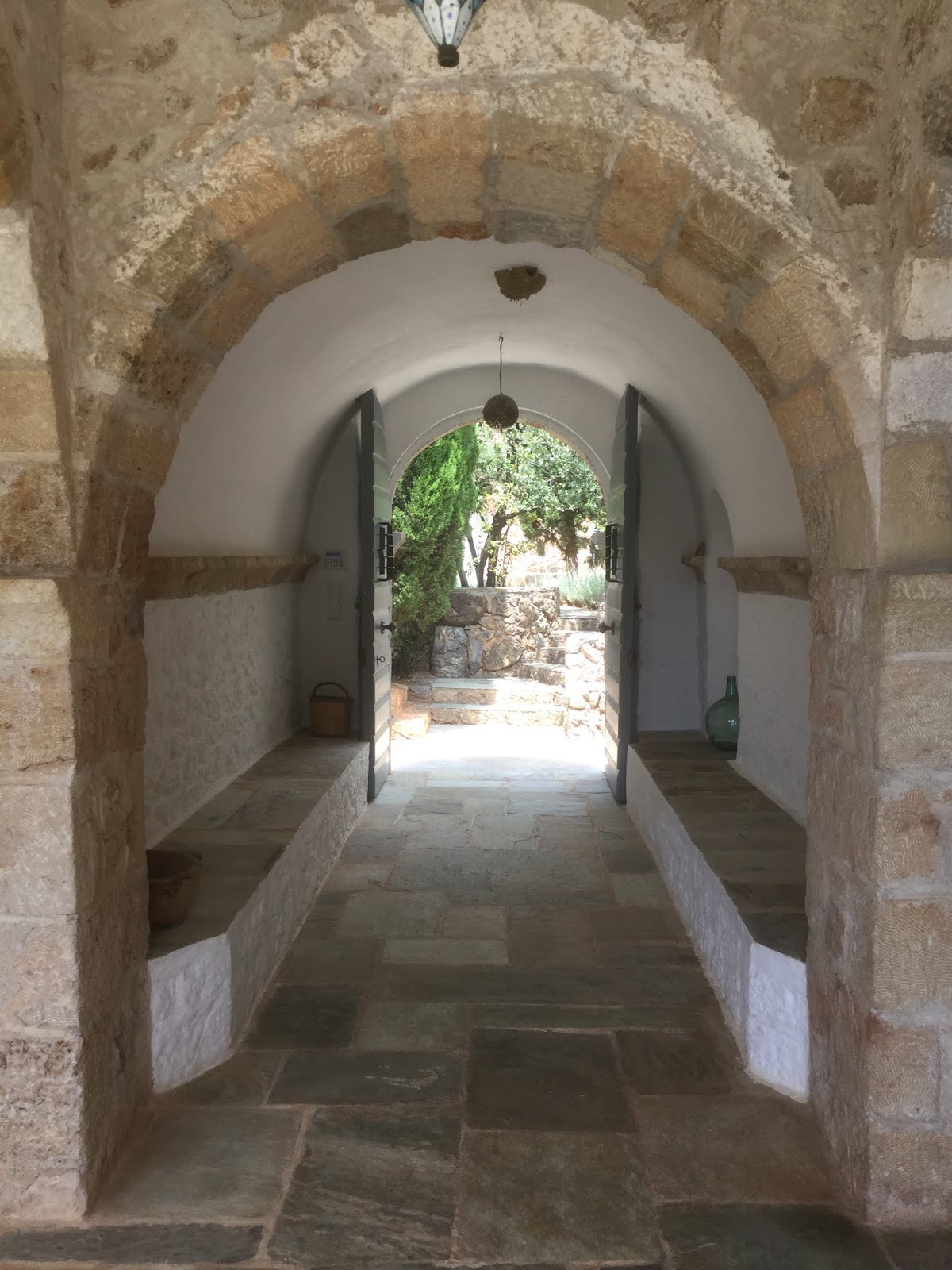
Behind the two-leaved entrance door a barrel-vaulted vestibule, lined with stone seating, leads coolly into the heart of the house: an arcaded gallery that joins the house’s two wings and looks out towards the sea. This gallery is open to the elements and resembles a fragment of mediaeval cloister. It is surprising, beautiful in itself and, even from inside, focuses the attention on the house’s sublime environment. From here an external stone staircase descends to the lower level of the house (there is also an internal wooden staircase), where the southernmost façade projects over an enormous vaulted arch, within which a seating area allows for al fresco eating. This is where the dinner in Richard Linklater’s Before Midnight (2013), starring Ethan Hawke and Julie Delpy, was filmed. We ate here too, whenever we could.

The salon
On the main level of the house there are four suites of rooms. The most magnificent room is the salon, which was beautifully described by Paddy Leigh Fermor himself in A. Lees-Milne & D. Moore, The Englishman’s Room (1986): p.91-95. Measuring about ten metres by five, this is the principal seating and dining area of the house. Its floor is made of green stone from Pelion, its ceiling is a fretwork of honey-coloured pine. At one end the room has a beautiful Turkish hayiati with divan set around it. A divan is set around the other end too, where, in winter, it is warmed by an astonishing stone fireplace, built to a Persian model. Into all the walls are set bookcases, each full of books. The salon opens onto the main terrace, which it matches for easy-going sociability. 

The sitting-room in Joan's suite
Also on this level are the two main bedroom suites, each consisting of a bedroom, a bathroom and a sitting-room. The suite that was Paddy’s has an undramatic view of the north of the property, and is restrained and introspective. Joan’s suite, by contrast, occupies the first floor of the southern wing of the house, and has a majestic view – on three sides – of the seascape and landscape. Captivated by the spectacle, we occupied this suite.

Between the bedroom suites lie the entrance vestibule and the spatious kitchen. The basement of the house has a bedroom, now with en-suite facilities, and was also used as a bookstore for Paddy’s enormous library; this has been converted into a study area. 

Paddy's study
Across from the main house is the studio that Paddy completed in 1969. It is a single-storey building, also of stone, with a pergola on the roof-terrace. Inside, it contains the study itself and a separate bedroom and bathroom. A small kitchen has also now been installed. The study has many bookcases, lined with books, and the author’s writing-desk. Like the suite of rooms that Paddy had in the main house, the study is an introspective space: the dramatic views of the shoreline are visible only with effort. The room turns around and into itself, focusing the mind on the task in hand. 

So much for the lay-out of the house. But what was it like to live there? 

From the start, the house seemed to me to imply a split personality or, to put it less dramatically, to express a dual purpose. On the one hand, the spaces for entertainment are among the most gregarious I have ever seen. The house cries out for guests to people it, for human conversation, for laughter and for times spent in good company. At the start of our stay, David and I were alone for three days in the house and we craved our friends’ company. We felt the character of the property change and lighten as our friends arrived; it came into its own.

Books everywhere
But the house is also a place for study and for intellectual pursuits. Even though the Benaki has removed some of the later bookcases (the removal of the excessive clutter is a good and necessary thing!), there are still books everywhere. Almost every room has spaces where you can sit down and read, and the same is true outside too. When you look up from your book, you may catch a glittering reflection from the surface of the sea or notice the gnarled form of an olive tree or admire the distant mountains across the gulf, but your eye soon returns to the book and you are absorbed again.

This dual use made me think at first of the villas of Roman intellectuals. At Tusculum, in the Alban Hills, Cicero had bought a villa that he laid out for intellectual relaxation (he built what he called an ‘Academy’ and a ‘Lyceum’, and wrote many of his philosophical treatises there). But the Tusculanum was also a very public place. From a later time, Pliny the Younger describes, in a lovely letter to his friend Pedanius Fuscus, how he would spend a typical day in the villa on his busy estates at Tifernum Tibernum, in modern-day Umbria: first dealing with business, then writing and reading (and sometimes going off on a hunt).

Something of this spirit certainly infuses the house that Paddy and Joan built. But as the days of our stay went on and even with the presence of our friends, I found myself increasingly impressed by the house’s solitude: its remoteness, its isolation, the constant sound of the sea. More like Cicero’s villa at Astura (which too was built on a promontory by the sea and was ‘secluded and free from observers if one wants to do some writing’) than the Tusculanum, the house strongly encourages solitude and solitary pursuits. The open arcaded gallery provides, I think, more than a mere hint of monasticism; it gets to the heart of the matter. 

Bust of Paddy
None of the suites of rooms internally connects with each other; they all open instead to the gallery. Since the gallery is unglazed, this must have been particularly challenging in the winter, causing the occupants to gather together around the large fireplace in the salon or to go it alone in their own rooms. The house reminded me that Paddy had written A Time To Keep Silence (1957), which recounts – somewhat surprisingly, since he didn’t otherwise appear to be interested in religion – the author’s experiences of monasticism, the interest he had in silence as a counterpart to his gregarious life. I shall now re-read that book because I suspect it unlocks a very important part of the personality of the house itself, a personality that seems to me strongly divided.

This in short is a glorious, intriguing, unique house and it was a huge pleasure and honour to be invited by the Benaki Museum to spend a week there. As I mentioned in my first blog, the house has been wonderfully restored and it now awaits both its official re-opening and, even more importantly, the arrival of the writers whose presence will implement the most important part of Paddy and Joan’s bequest. I wish them every inspiration and congratulate the Benaki Museum and the Stavros Niarchos Foundation on a magnificent restoration job. 

John 

The external stone staircase
Space for eating 'Before Midnight'

Tuesday, 13 August 2019

Return to Mani - Part 1

Gulf of Patras
The ferry from Bari hugged the northern shore of the Gulf of Patras. We had made this journey six years earlier when the boat from Brindisi brought me to Greece on the start of my adventure as British Ambassador. In January 2013, there was a heavy fog on the Ionian and over the gulf itself, and we saw the glorious Rion-Antirrion bridge only as we docked at Patras. Now, however, the morning light was sharp, the sky largely cloudless and blue. I picked out easily the large lagoons behind the foreshore, in the near distance Mesolonghi, the Pindus range rearing menacingly above. Thoughts of the revolutionary war swirled around my head: the naval actions - Codrington blocking and instructing Ibrahim Pasha’s fleet in early October 1827 before the final encounter at Navarino; Frank Abney Hastings aboard the fighting steam-ship Karteria; the campaigns on land - poor Mesolonghi three times besieged before the fatal, heroic Exodos; the political arguments about the future shape of the Greek state; and Byron, of course - the young man setting foot in Epirus in 1809 to search for Ali Pasha in his Albanian lairs, and fifteen years later the prematurely aged Archistrategos slowly, feverishly bled to death by his doctors. The community at Mesolonghi had shown us great hospitality in 2015, when the UK was the ‘most honoured nation’ at that year’s Exodos commemorations. It was my first taste of smoked eel, a local speciality: unimaginably good. All of this compound of ideas, associations and memories meant that I was undoubtedly back in Greece. Greece, my beloved Greece.

Some archetypes
Away from Athens, with its political machinations and sophisticated, frenzied way of life, it is easy in Greece to return to basics, to feel the archetypes reassert themselves. Life impresses through repetition of simple things: an olive tree, a fig, a giant terracotta pot, pebbles on beaches, the fragrant earth, gentle seas, boundless sky. It finds expression in stark, vivid colours: the rippling silver-green of an olive grove, the baked orange soil, whitewash on grey stones, and everywhere the intense Greek blue, reaching down from the skies to merge with the sea, turning to turquoise in the shallow bays and creeks. Tastes too are simpler: olives, country bread, salty feta, huge but sweet tomatoes, barbounia, a chilled ouzo or a palatable glass of a local rosé.

This year, we have spent a week in the Mani, as the guests of the Benaki Museum in the house built at Kalamitsi by Paddy and Joan Leigh Fermor. Paddy and Joan decided to gift it to the Benaki in 1996, and it became the museum’s possession in 2011 when Paddy died (Joan had predeceased him). The bequest brought an entail: that the house be turned into a retreat for writers and used for educational purposes. This was no easy task: the house had been built from 1964 to the designs of architect Nikos Hatzimichalis, and it had scarcely been modernised since. I visited it in 2015 and saw at once how much work would be needed to make the house function for its new purpose. Re-wiring, mending the roofs, replacing rotten windows, doors and shutters, renewing bathrooms and kitchen, installing air-conditioning and wi-fi, cataloguing the thousands of books, looking after the original works of art (Leigh Fermor owned important pieces by Craxton, Ghika and others), improving the security of the property, thoroughly cleaning and redecorating - all of this was going to be a substantial undertaking. And it was clearly going to cost a lot of money: money that would have to be raised, since no money accompanied the bequest of the house itself.

The house in its setting
Thanks to the determination, skills and planning of the team at the Benaki a large grant was secured in 2016 from the Stavros Niarchos Foundation. The work began at once and was completed a couple of months ago. The restoration is magnificent: it has been done to the highest of specifications, but has also preserved the authenticity of the original designs. It still feels like a home: not an ordinary home, but the home of two immensely talented people whose characters, tastes and needs (for privacy, for company) are stamped in the stones and architecture themselves.

The house is now receiving guests: there are guided tours three times a week, every Tuesday, Thursday and Saturday at 11:00 am. Reservation is required by email at leighfermorhouse@benaki.gr or by phone at +30 210 3671090 (Monday to Thursday). A VIP launch is planned in October. From next year, writers and educational establishments will be invited to use the house, in line with the wishes of Paddy and Joan. And, from summer 2020 for three months a year, it will be possible for others too to rent the property. You can find booking information at www.ariahotels.gr.

The house from the beach
In my next blog I will say more about what it was like to live in the house for a week. (SPOILER ALERT: It was glorious.) But I will close now by expressing my admiration and thanks to the Benaki Museum and the Stavros Niarchos Foundation for the magnificent work they have done to conserve and transmit to future generations this unique legacy. There is no one who will fail to fall in love with and be inspired by this beautiful house in its beautiful landscape and seascape. 

...to be continued.

John


The entrance vestibule


A Child of Thetis. Travellers in Greece. An Occasional Series. 6 Christopher Kininmonth

When I visited Phaestos at the end of my stay I felt almost listless as the car swung into view of the southern plain fringed with mountains...

Most viewed posts